Innovation Strategy · Northwestern Kellogg
Valvoline Care+
Out-of-warranty car owners drift away from preventive maintenance — and that drift costs them safety, resale value, and money. We built the case for a subscription model that makes car care a habit again.
- My role
- User Research + Product Design + Mockups and Testing
- Team
- 4 (Kellogg)
- Course
- Innovation Strategy
- Outcome
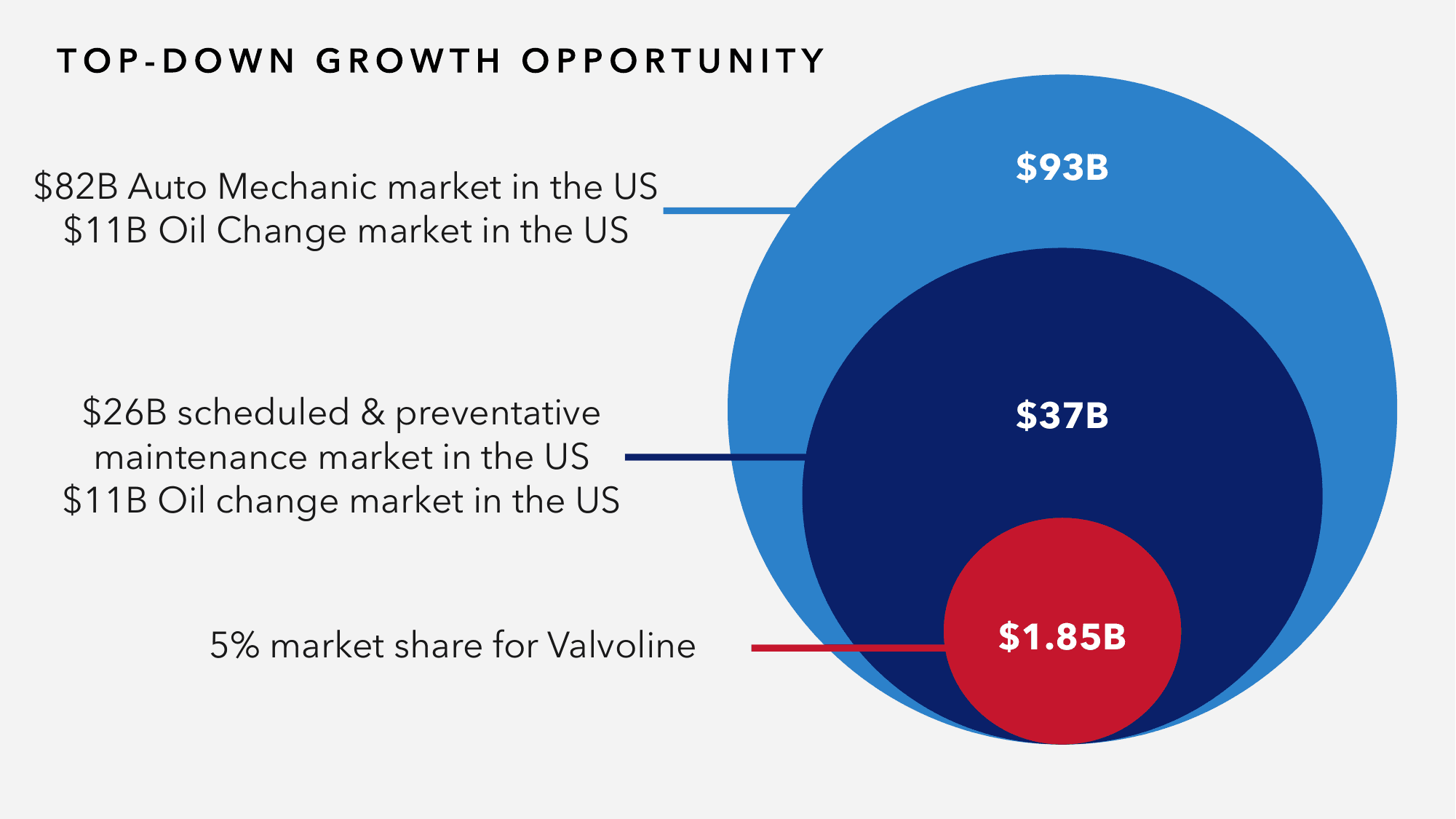
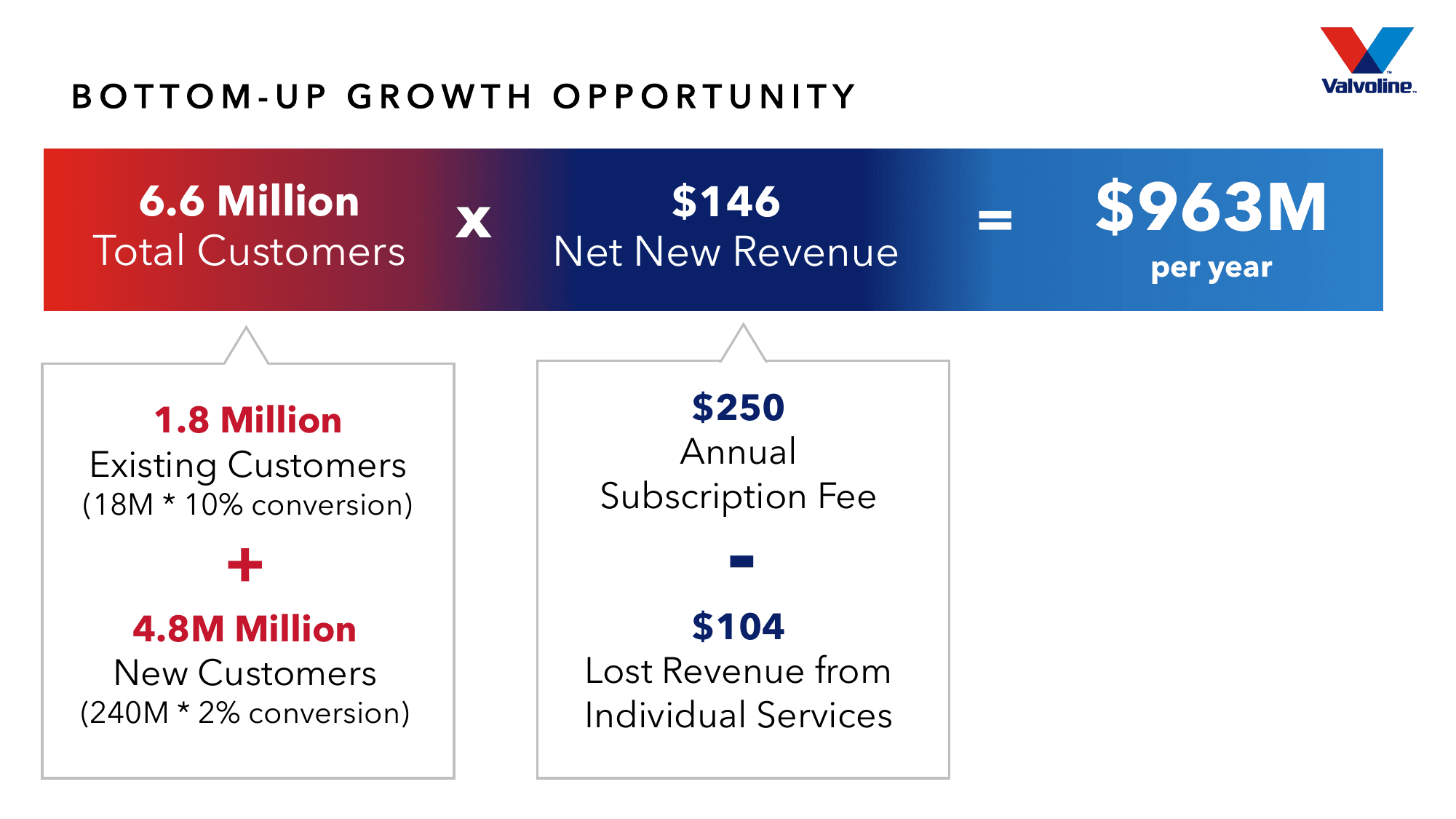
- $1.85B opportunity sizing + test plan
The problem
Out-of-warranty car owners have inconsistent maintenance over time.
Car owners are diligent about following the dealer's service schedule while the warranty is still in force. Once it lapses, adherence starts to fall off. People remember oil changes — that's the ritual the industry has trained them on — and forget almost everything else: transmission fluid, brake fluid, coolant, tire rotation, the drumbeat of small services that keep a car safe.
What looks like a saved $50 in the short term ends up as an unexpected repair, a lower resale price, or — at worst — a preventable accident. The behavior gap is real, persistent, and expensive on both sides: customers lose money, and Valvoline loses the share of wallet that comes from a car owner's full service schedule, not just the parts of it they remember.
The solution: Valvoline Care+
An annual prepaid subscription that covers every recommended maintenance service for the year, with proactive reminders and a digital service record that follows the car.
Care+ is a flat-fee subscription with four benefits braided together: a single price for a year of recommended services, automated reminders so customers never miss the next one, a digital service record that proves quality at resale, and learning resources that explain why each service matters. Together they convert one-shot oil-change customers into year-long relationships.
Three things make Valvoline uniquely positioned to ship this. The brand is already trusted (mile sticker on every windshield, decades of tagline). The repeat rate is already 80%. And Valvoline already has the maintenance schedules — they just haven't been packaged as a recurring product.
How Care+ creates value
Annual prepaid subscription
Value for customer
Prevents unexpected services and surprise expenses. One number for the year.
Value for Valvoline
Guarantees business from each customer for the entire year ahead.
Automated service reminders
Value for customer
Adherence to maintenance schedule improves the safety and reliability of the car.
Value for Valvoline
Brings customers back more frequently, increasing upsell opportunities at each visit.
Comprehensive digital service records
Value for customer
Proof-of-quality for insurance and a higher resale price when selling.
Value for Valvoline
Switching cost — customers stay with Valvoline to keep their record complete.
Maintenance learning resources
Value for customer
Helps owners understand why each service matters before paying for it.
Value for Valvoline
Justifies the subscription's value and the role of routine servicing.
Why Valvoline can win this
- 01
Trusted brand at scale
Decades of mile-sticker reminders means Valvoline already lives in customers' heads as the maintenance brand.
- 02
80% repeat rate
The customer base doesn't need to be acquired — it needs to be activated into a deeper, longer relationship.
- 03
Schedules already exist
Valvoline knows the right cadence for every common make and model. The hard part isn't knowing what to recommend; it's getting the recommendation in front of the right person at the right time.
The story we told
The class final was a pitch. To make the pitch land, we traced one customer through four moments — the surprise bill, the Care+ choice, the prevented repair, the resale — using hand-drawn figures the whole way through.
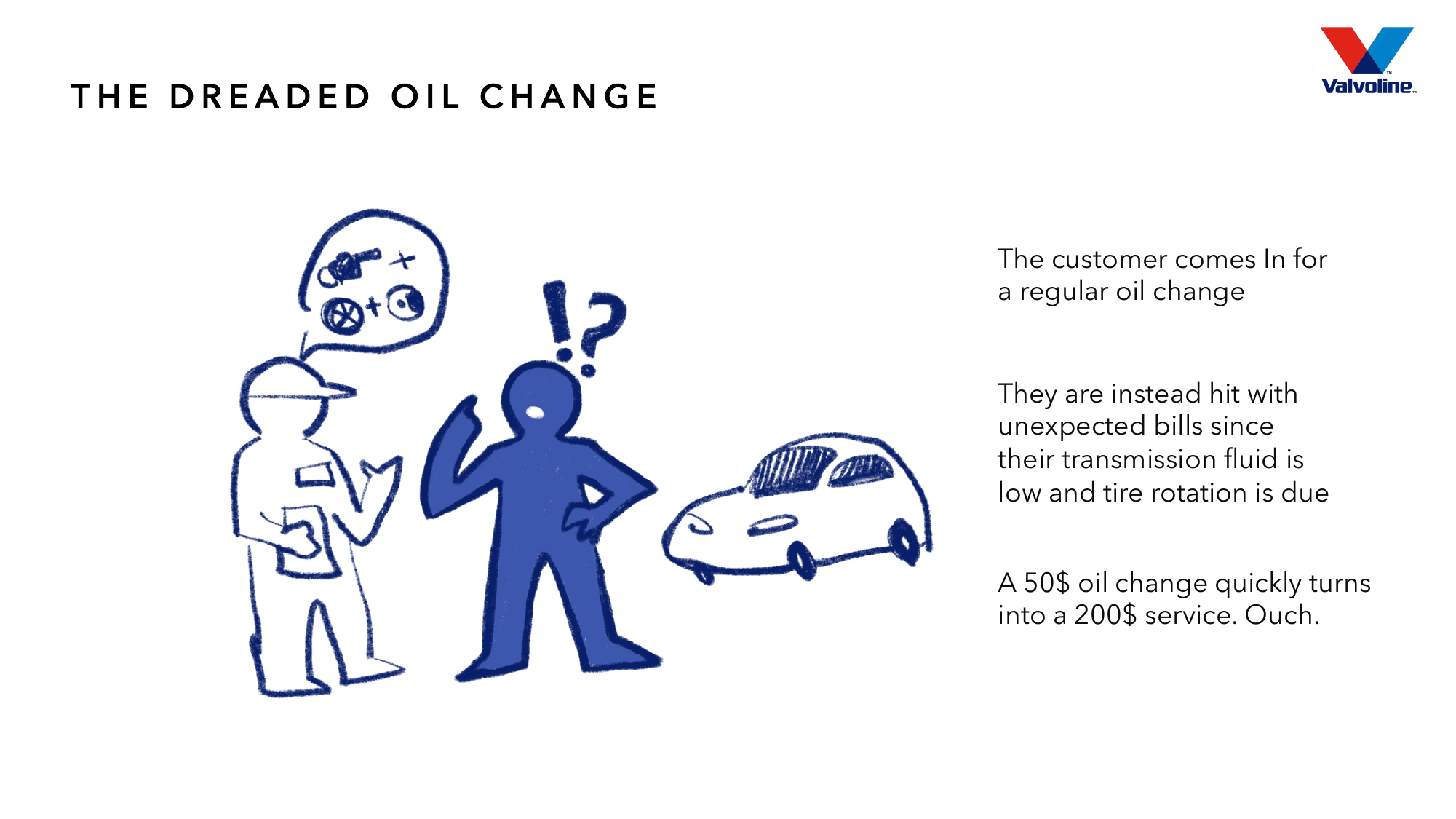
The dreaded oil change. A $50 visit becomes a $200 visit because the transmission fluid is also low and the tire rotation is overdue. The customer leaves frustrated — and resolved to skip the next few services to recover the cost. The maintenance debt grows.
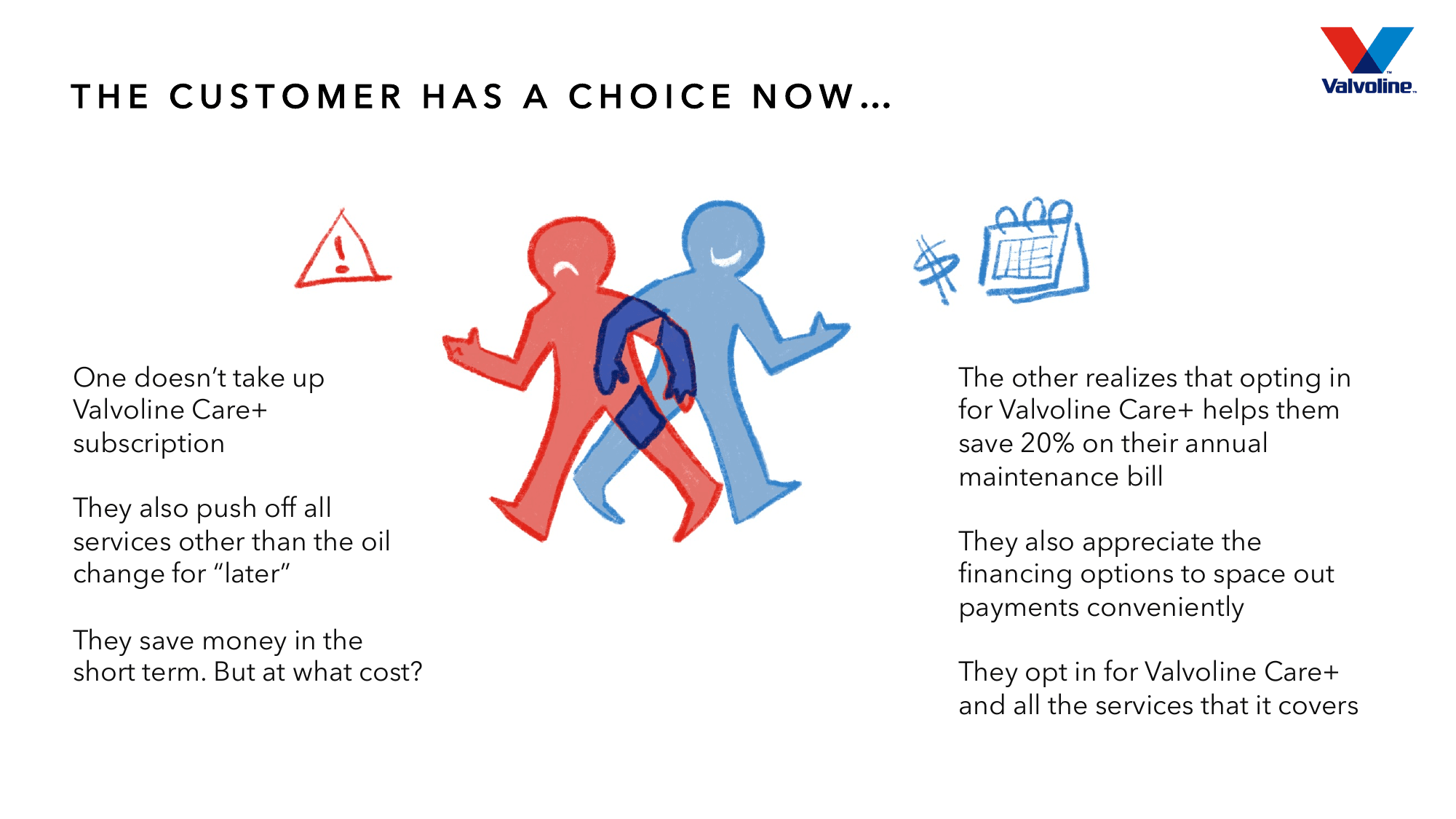
With Care+, the customer has a different choice. Instead of deferring the unexpected services, the bundled price with financing options means the math works in their favor — they save 20% on the year, and they get every service they need.
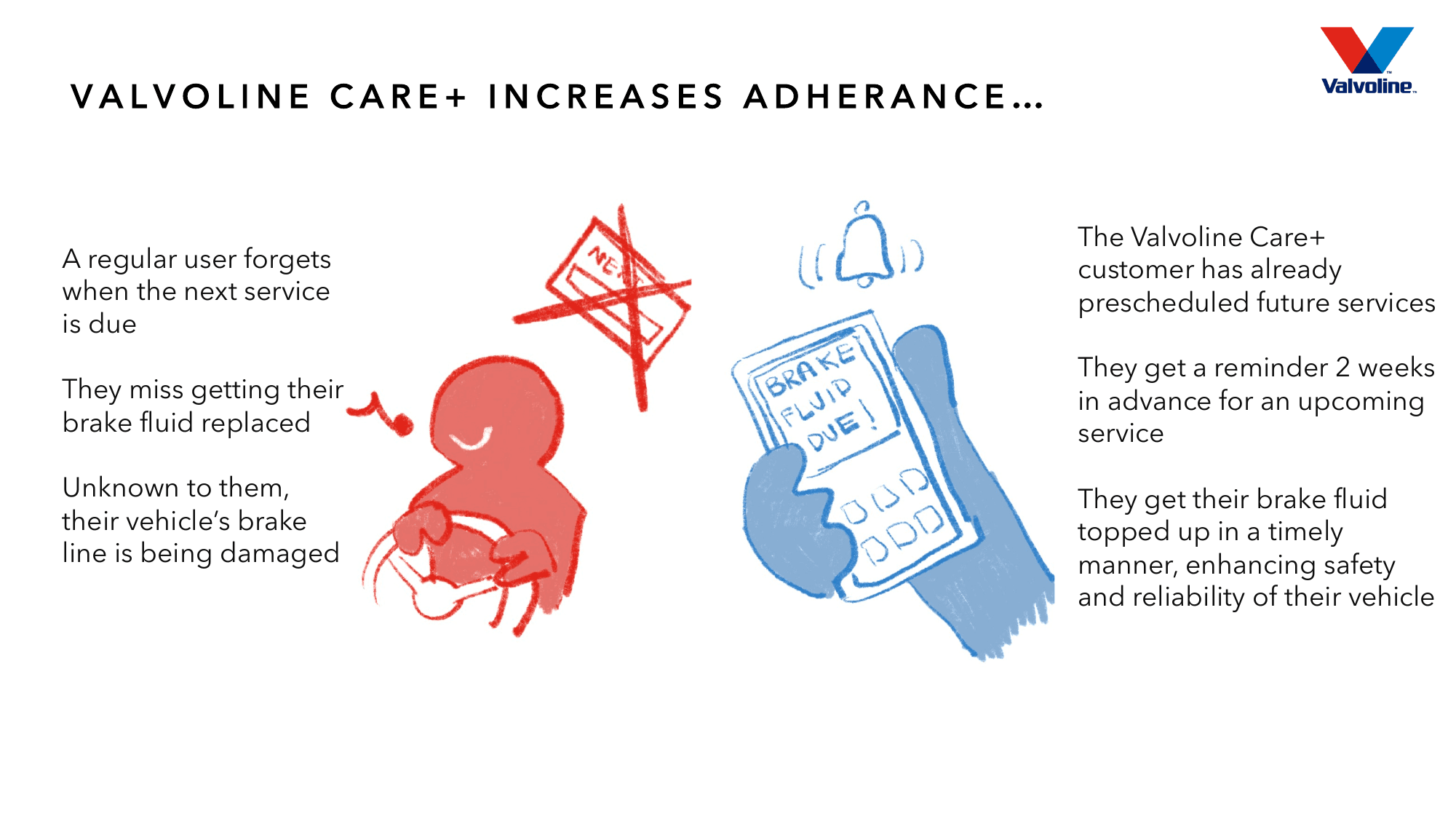
Adherence becomes the default. A two-week-out reminder means the Care+ customer doesn't have to remember the brake-fluid cycle — and brake-line damage that would have happened invisibly in the background gets caught at a routine visit instead.
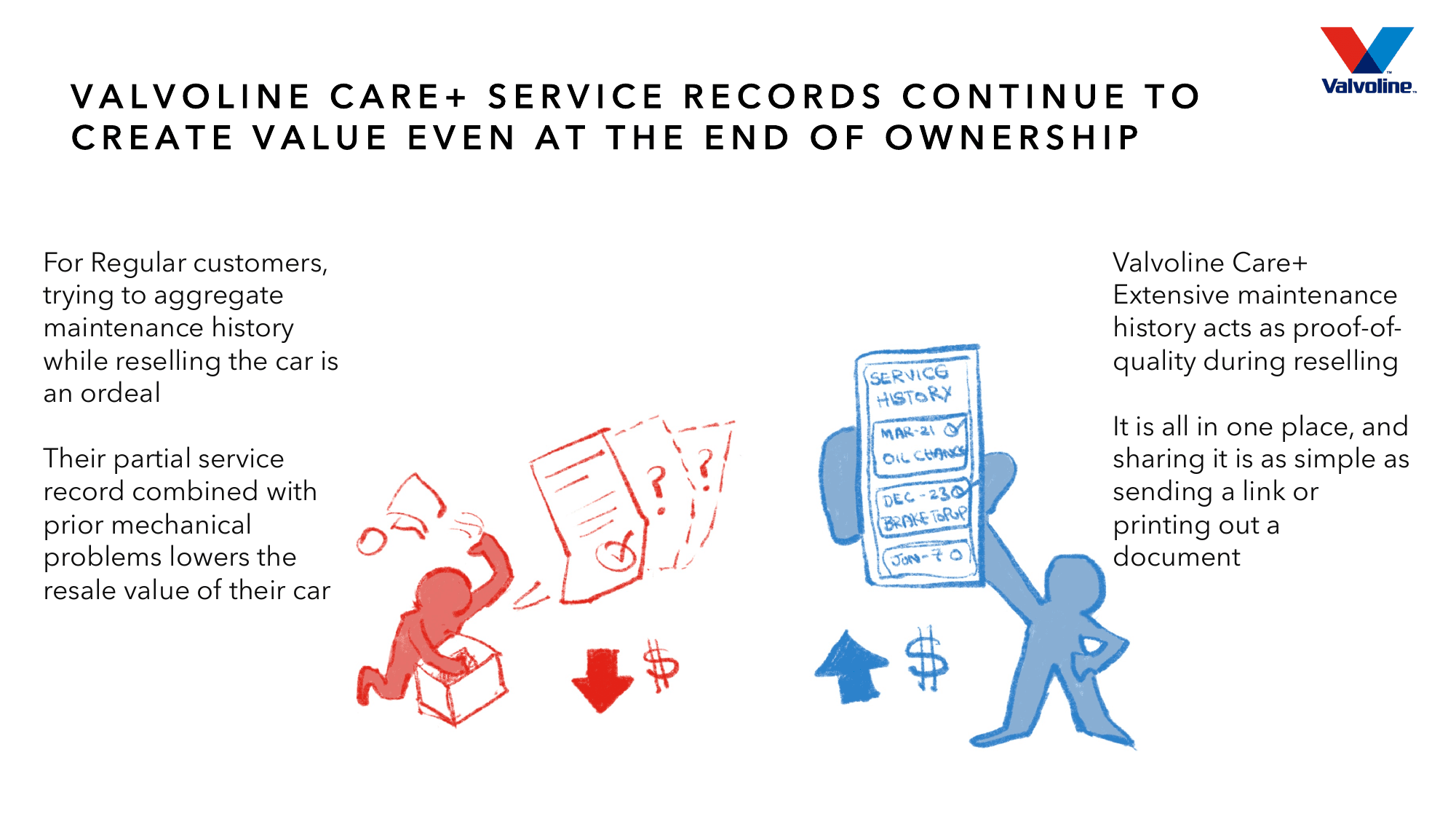
And at end-of-ownership, the digital service record turns into resale value. A complete maintenance history is proof-of-quality. For Care+ customers, sharing it is one link or one printout — not an afternoon of digging through receipts and email confirmations.
Sizing the opportunity
We sized the market two ways and found the same shape from both directions: a low-billions opportunity that's serious but not fantastical, even with conservative conversion assumptions.
Pressure-testing the assumptions
The course pushed us through a seven-category framework: Brand, Experience, Channels, Profit, Partners, Capabilities, Offering. For each, we mapped where Valvoline's existing strengths supported the new offering (synergies) and where the gaps lived (tensions). Tensions became the assumptions we needed to test.
The deck has the full audit. Below is the compressed version — one card per category, with the headline synergy and headline tension we surfaced.
- Brand01
The customer profile and our brand promise.
- Synergy
- Valvoline already promises affordable, convenient services that extend the life of customer vehicles.
- Tension
- The brand reads as 'in-the-moment convenience.' A subscription requires conveying proactivity and discipline around customer data.
- Experience02
The user's goal and how we help achieve it.
- Synergy
- Mileage-based reminders (the windshield sticker) and in-store maintenance prompts already exist.
- Tension
- Hooking into onboard car telematics requires technical capability and OEM partnerships Valvoline doesn't currently have.
- Channels03
How we attract, engage, sell, and ship.
- Synergy
- Strong existing presence in digital + traditional marketing, email/text newsletters, and local advertising.
- Tension
- Customers will need a compelling mobile/web experience to manage their subscription, records, and perks long-term.
- Profit04
Revenue sources, costs, and anticipated profit.
- Synergy
- Valvoline already optimizes profit per service visit; more 'expected' services per visit raise the average ticket.
- Tension
- Standalone willingness-to-pay for the 'intelligence' layer is unclear. Bundling has to avoid cannibalizing primary profit streams.
- Partners05
Capabilities best obtained via alliance or acquisition.
- Synergy
- Extended franchise network can roll out new capabilities quickly.
- Tension
- Robust OEM relationships for telematics access don't exist yet — that's the partnership we'd need to build.
- Capabilities06
People, process, and tech to launch.
- Synergy
- Strong existing service-location network, skilled technicians, state-of-the-art equipment.
- Tension
- Data collection + analysis and web/mobile app development have to be developed or acquired.
- Offering07
Our solution and advantage over the competition.
- Synergy
- Location ubiquity and scheduling flexibility match individual maintenance needs.
- Tension
- The technical layer (telematics + predictive recommendations) is genuinely new for Valvoline — built or bought, not borrowed.
How we'd test it
- 01
Demand for proactive alerts (Light)
15–20 interviews with current and potential customers about maintenance habits and openness to proactive alerts. Quick, qualitative — directional only.
- 02
Willingness-to-pay (Light)
Survey distributed broadly to gauge price sensitivity and perceived value of a stand-alone vehicle monitoring service.
- 03
Pricing model preferences (Medium)
Scenario-based survey comparing flat fee vs. tiered pricing. Identifies the structure customers prefer before we commit to one.
- 04
Subscription impact on visit frequency (Strong)
A/B test: one customer group on the subscription model, one on traditional pay-per-visit. Six months. Compare visits, average spend, retention.
- 05
MVP perks and engagement (Strong)
Small group on a high-touch MVP subscription. Manually track usage and follow-up satisfaction. Tells us whether the perks actually create loyalty.
Reflection
What I'd do differently next time: start with the tensions, not the synergies. We spent a lot of energy in the first half of the project building enthusiasm for the offering — easy to do, because the surface logic is compelling. The seven-category audit forced honesty late in the project. Pulling that audit forward by three weeks would have meant we tested the right assumptions sooner.
What surprised me: the highest-leverage feature wasn't the subscription pricing or the alerts. It was the digital service record. Customers cared more about being able to prove maintenance history at resale than about the day-to-day convenience of subscription billing. That insight reshaped how we framed Care+ from a "save money" pitch to a "protect your asset" pitch.
What I'd carry into other work: the synergy/tension framework translates well outside an Innovation Strategy class. For any new offering, asking "where does our brand already reach for this, and where does it stretch?" forces a clearer view of what's actually new versus what's a repackaging of existing strengths.
The full deck
33 slides: the full pitch + the seven-category Innovation Strategy framework with all synergies, tensions, and assumptions per category.