Ethnographic Research · Northwestern Kellogg
The Knot
I spent an afternoon in Azka's living room, watching how she and Seemab turn financial discipline into an act of love — and what The Knot could build to support couples like them.
- My role
- Solo researcher
- Course
- Customer Understanding (Kellogg)
- Duration
- 10 weeks · Fall 2024
- Method
- 1 in-depth interview · 60 minutes
The brief
The Knot is best known as a wedding planner. Their growth question: what's beyond the wedding? Engaged and newly-wed couples often obsess over planning a single event, then have nowhere to channel that planning energy after they say "I do." Knot wanted to know whether a brand built on weddings could earn the right to live alongside couples once the wedding is over — specifically in the domain of family financial planning.
I was asked to study the consumer, the category, and the brand. The research was meant to surface how a financially-deliberate couple thinks about money individually, blends it during a wedding, and manages it together afterward — and what role a brand like Knot could plausibly play in that arc.
How I approached it
The course's "Insight Muscle" framework: three skills (observe, listen, inquire) and three mindsets (curiosity, introspection, empathy). The point isn't just to gather data — it's to reflect on yourself enough to see the customer clearly.
- Skill01
Observing
Pay attention to what the customer does with deliberateness — the artifacts, behaviors, and small choices that signal what they value.
- Skill02
Listening
Go beyond hearing what they say. Listen for what they mean — the patterns, repetitions, and silences underneath their words.
- Skill03
Inquiring
Use observations and patterns to surface the customer's underlying motivation, then audit your discussion guide against it.
- Mindset04
Curiosity
Stay aware of what you still don't know. Plan the next research step before you've finished writing up this one.
- Mindset05
Introspection
Compare a subculture you belong to with the customer's. Notice what your assumptions reveal about you, not them.
- Mindset06
Empathy
Find a genuine personal connection. Use it to design something for the customer that comes from understanding, not extraction.
Meet Azka
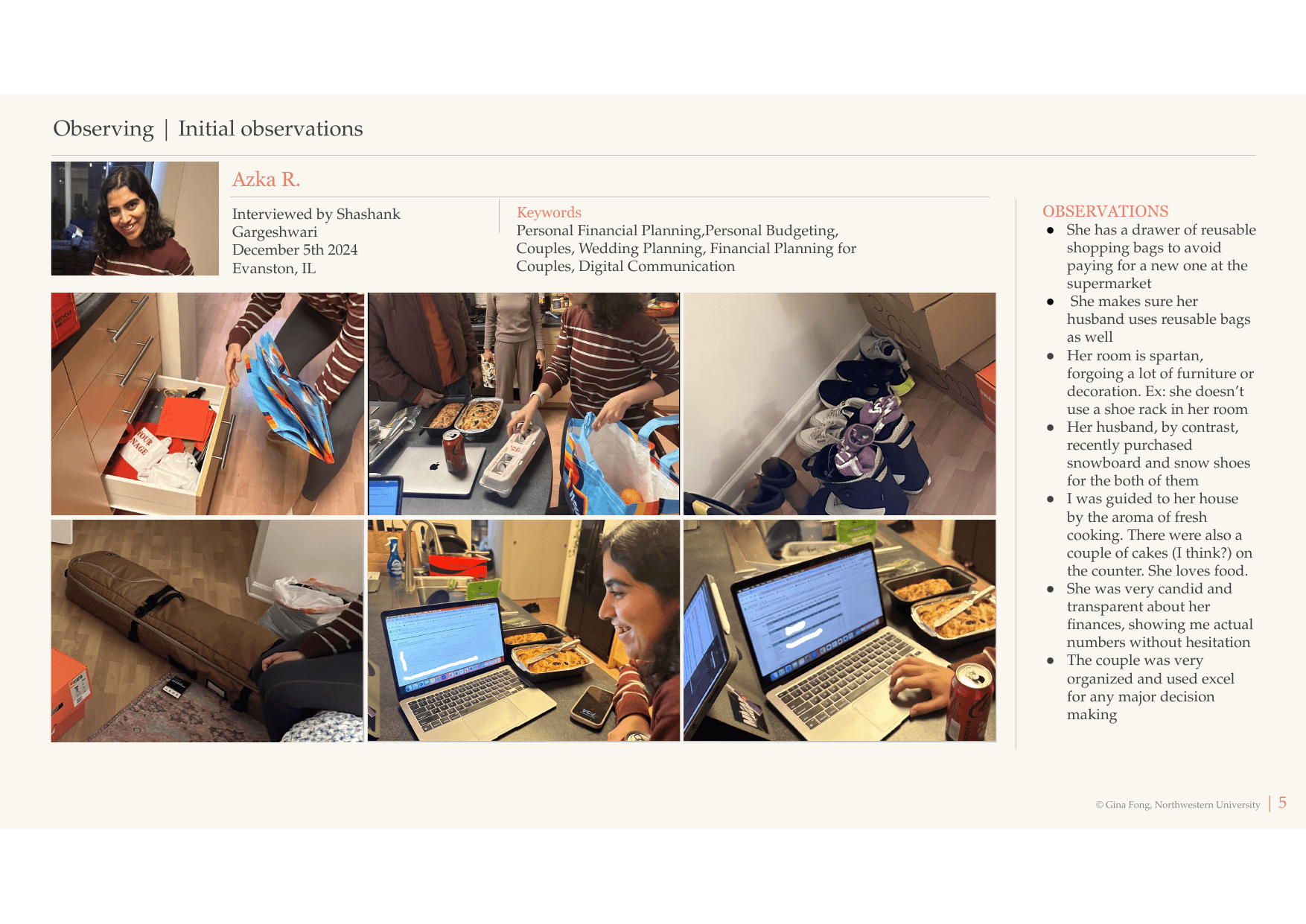
Azka is in her late 20s. She's recently married to Seemab, an MBA student. She lives in Evanston, in an apartment that — as I noticed the moment I walked in — is almost spartan. No shoe rack. Minimal decoration. And yet the place feels alive: cakes cooling on the counter, the smell of fresh cooking, two photo albums waiting on the coffee table for me to look through.
She agreed to the interview within hours of being approached. When I asked about her finances, she pulled up a spreadsheet on her laptop and showed me actual numbers. Not a redacted version, not a sanitized summary — the whole thing. That openness set the tone for the rest of the afternoon.
What we learned
- 01
Reusable bags, everywhere
A drawer full of them. She makes sure her husband uses them too. The bags weren't a one-time purchase — they were a small daily discipline. A frugality of habit, not deprivation.
- 02
A spartan apartment, but not a cold one
No shoe rack, no extra furniture, no decoration for its own sake. But cakes on the counter. Two photo albums on the coffee table. The minimalism is intentional, not absent.
- 03
Snowboards in the corner
Her husband bought a snowboard and snowshoes for the two of them this winter. The 'small' spending is for shared experiences — and she didn't bring this up as friction, she brought it up with pride.
- 04
Excel for everything that mattered
Wedding budget: Excel. Vendor comparisons: Excel. Dress shortlist: Excel. Bi-weekly couple finance review: Excel, on a recurring Zoom. Decisions of weight got a structured artifact; decisions of taste got delegated to her partner.
“This is the wedding. This is my house in the background. This is the sofa that I grew up on. These are the stairs that I climbed up to my room. And then my favorite picture: this is a swing in our house where all the kids play. So I just really wanted to have a picture here.”
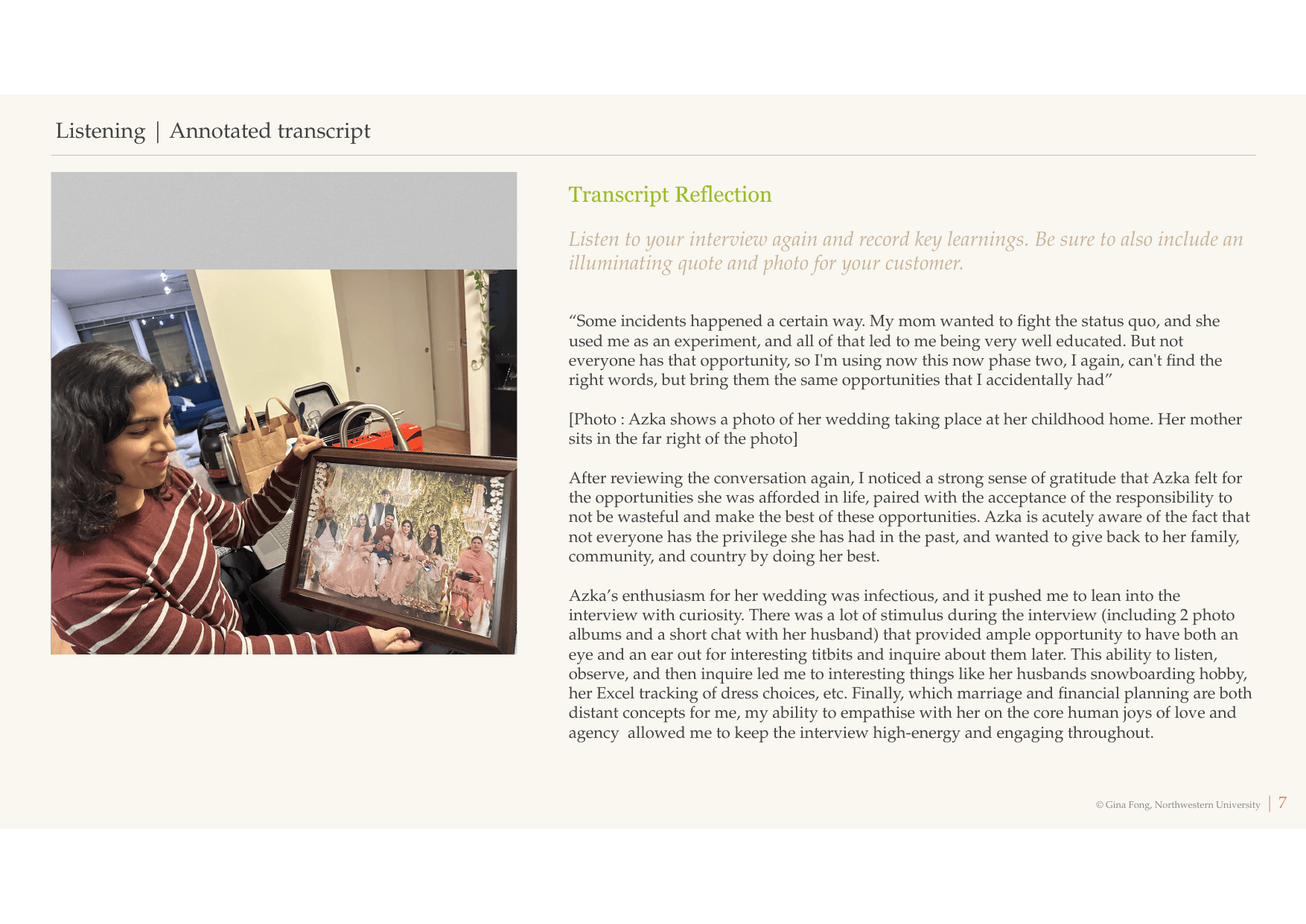
She had her wedding at her childhood home. Not at a venue, not at a destination — at the same sofa she grew up on, the same stairs, the same swing. Frugality wasn't the framing she used. The word she used was 'meaningful.'
From observations to motivation
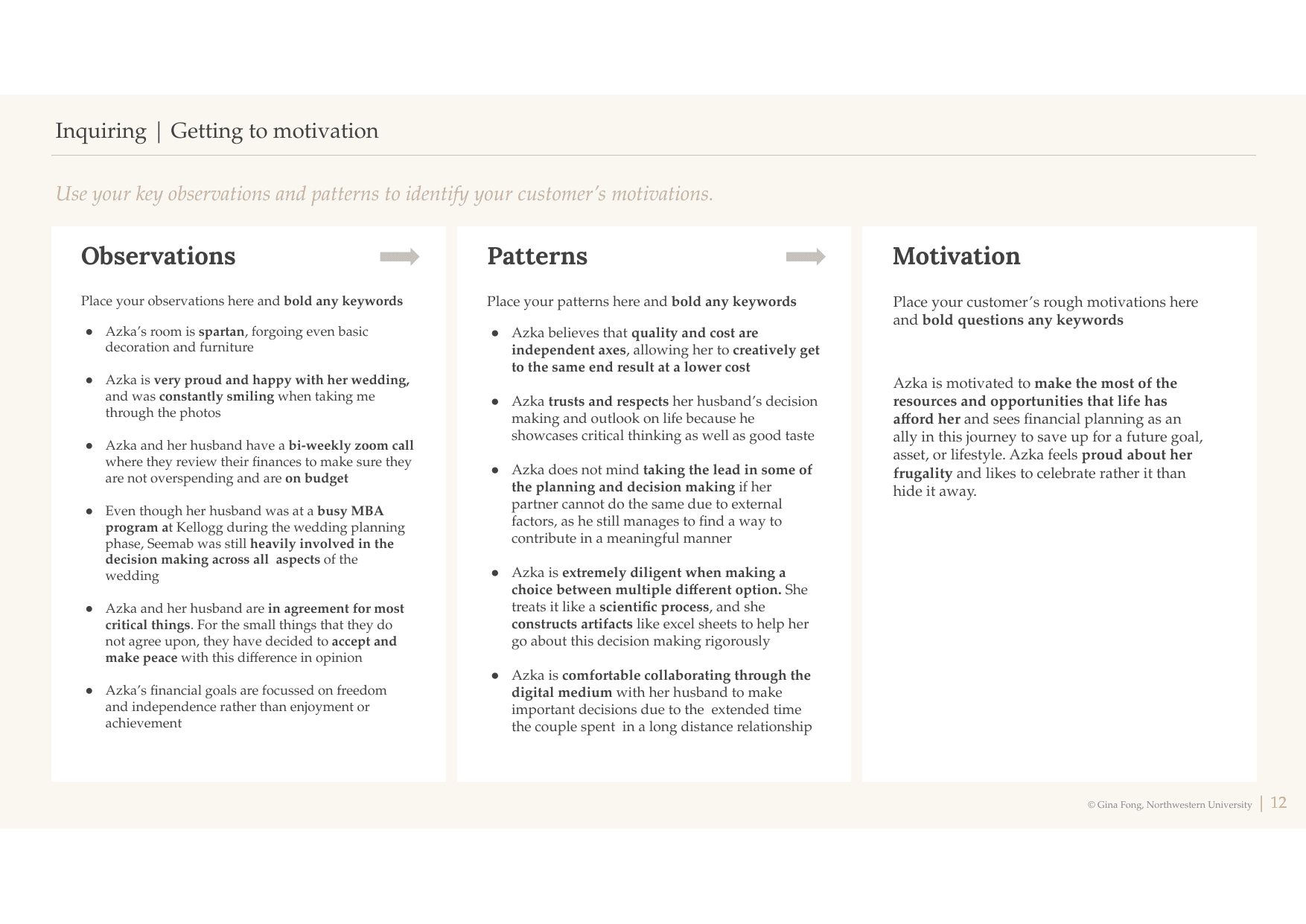
The patterns assembled themselves slowly. Across the bags, the spartan apartment, the snowboard, the Excel sheets, and the home wedding, one thread kept showing up: Azka treats quality and cost as independent axes. She doesn't accept the trade-off most people do — that less expensive must mean less special. She thinks her way around it.
A second thread: she trusts her partner's decision-making completely, even when she's the one running the spreadsheet. The Excel doesn't exist to override him; it exists so they can both see the same picture and decide together. The discipline is collaborative, not controlling.
Her motivation, when I tried to write it in one sentence: she wants to make the most of the opportunities life has handed her, and she sees financial planning as the ally that lets her save up for a future goal — without losing her ability to celebrate the present.
Finding a personal connection
The course asked us to map a subculture we belong to against the customer's. The exercise was uncomfortable in the best way — it forced me to notice my own assumptions about people who track finances rigorously.
I'm a budget watch collector. I love watches that cost a tenth of what "real" watch enthusiasts spend, and I love them precisely because they let me participate in something I care about without paying the price of admission a snobbier version of the hobby would charge. On a recent trip to Dubai, I spent two days in the mall not at Patek Philippe or A. Lange & Söhne, but tracking down a plastic Swatch version of the Blancpain Fifty Fathoms — a watch that meets the exacting design language of a $13,000 timepiece for less than 1% of the cost. It's now one of my favorites.
What that subculture taught me: there's a particular kind of creativity that hides inside frugality. Finding the cheap-but-soulful object isn't compromise — it's craft. And before this interview, I was carrying around an assumption that financially deliberate people were doing it to feel superior. Azka showed me they're often doing it for the same reason I'm collecting cheap watches: to be in the world without letting price tags decide who gets to participate.
That reframe was the hinge of the whole project. It changed what I thought The Knot could offer — not a more powerful budget tracker, but a tool that respects the creativity already at work in how couples like Azka and Seemab plan their lives.
What The Knot could give Azka
A small product idea, sized to the scope of a class assignment but grounded in the research. Not a full strategy — a thought experiment the team could pressure-test.
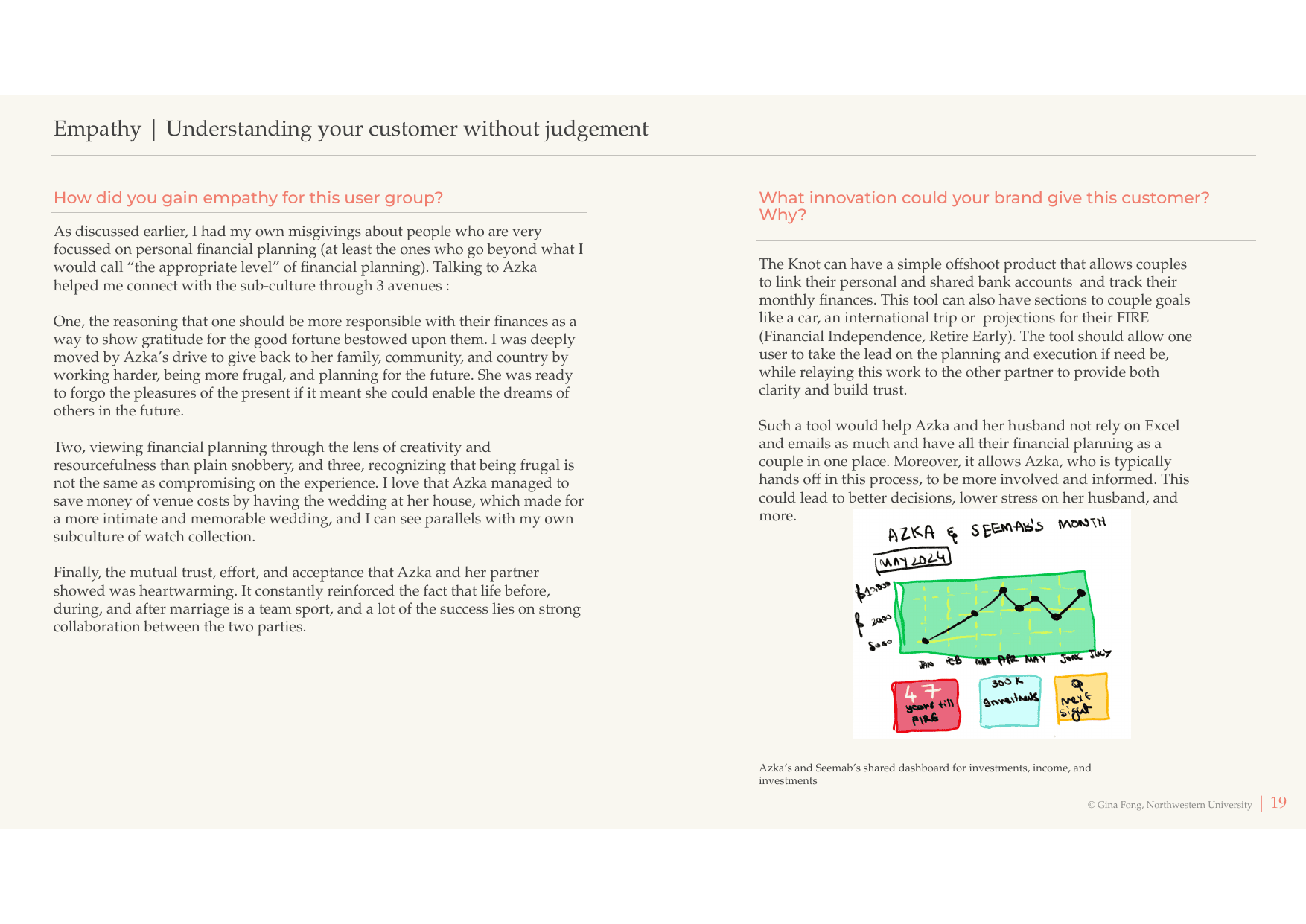
The Knot already owns the wedding moment. The proposal: extend the platform into family financial planning by linking a couple's personal and joint accounts, tracking their shared goals (a car, an international trip, FIRE projections), and letting one partner take the lead on planning while the other stays clear-eyed and informed.
Today, Azka and Seemab live this on Excel and email. The opportunity isn't to replace Excel — it's to give them what Excel doesn't: a shared dashboard with both their views in it, a place to celebrate hitting a savings milestone, and a brand whose voice knows how to talk about money like a couple does, not like a bank does.
What I'd carry into the next interview
My discussion guide was conservative. I was so worried about keeping the focus on Azka that I avoided asking about Seemab — and Azka kept bringing him up anyway. The richest material in the whole interview was about her perception of his decision-making. Next time: ask about the partner directly, even when the subject is a single person.
I learned that the artifacts on a customer's coffee table are not decoration. The two photo albums and the Excel sheet were the interview. Once Azka started narrating them I stopped following my guide and just asked about what she was pointing at. That was the right move; I should be braver about it sooner.
And the introspection step — comparing my watch hobby to her frugality — ended up being the most useful tool in the whole framework. I'd use it on every project I do from now on. Designing for someone without first noticing how you're already projecting onto them is, I think, where most user research goes quietly wrong.
The full deck
57 pages: project scope, screener, discussion guide, and the full customer reflection (observation, listening, inquiring, curiosity, introspection, empathy).