Innovation strategy · Northwestern MMM × Barilla
Barilla For You
Using ethnographic research to help a carbs-first pasta company adapt to the rise of AI-driven personalization in health and fitness.
- My role
- User ResearchProduct DesignPrototyping
- Team
- 5 MMM students × 3 Barilla personnel
- Duration
- 12 weeks · Fall 2024
- Outcome
- Step / Stretch / Leap roadmap
Faculty Advisor: Craig Sampson
How can we, as a pasta manufacturing company, position our products and messaging to be part of the solution for consumers who engage with AI-driven personalized health solutions?
What's at stake
Search for "healthy pasta" and Barilla doesn't appear in the top results. In an era when consumers increasingly ask AI what to cook for their goals, absence from those answers is a strategic risk for a brand built on the world's most-eaten staple.
Three forces are converging at once. The U.S. wellness market is expanding past $1.8 trillion. Wearables and AI tools are reshaping how people think about nutrition — 7 in 10 early adopters trust AI for health information, and 71% who've used it for health believe it will transform healthcare. And the "healthy pasta" category — once Barilla's by default — is now crowded with chickpea, lentil, and high-protein challengers.
If a Barilla customer is starting a fitness journey, talking to ChatGPT for a meal plan, or wearing a CGM, the brand has no obvious answer to the question they're now asking: what should I eat to hit my goals?
How we approached the question
We ran a 12-week mixed-methods study. Secondary research mapped the AI-in-healthcare landscape, U.S. wellness trends, and the wearables market. Primary research was 16 in-depth interviews with health-conscious, tech-savvy consumers, sourced through dScout from a screening pool of 200.
75% were existing Barilla customers but 0% had tried Barilla Protein+. 82% wanted to change their body composition; 47% were managing a health condition or allergen. Crucially, every participant had used a fitness tracker or digital health tool — they were already in the AI-personalized-health world we were trying to enter.
- 16
- In-depth interviews
- 200
- Initial screening pool
- 100%
- Tracker users
- 75%
- Existing Barilla buyers
What we heard
Four insights crystallized from the interviews. They reframed the challenge from "how do we sell more healthy pasta" to "how do we meet people in the messy, emotional reality of their health journeys."
People undertaking personal transformations crave accomplishment and empowerment. Digital tools bridge the gap between aspiration and action.
Calls to action come from milestones (a marathon), social context (a wellness stipend at work), health events (a doctor's note), or fulfillment (keeping weight off). In every case, the digital tool was the first step — YouTube, TikTok, ChatGPT, MyFitnessPal — before any food decision.
Instead of feeling empowered, people end up fatigued, overwhelmed, and restricted by the rigid, tedious nature of tracking.
The same tools that started the journey eventually broke it. Tracking became a chore. Data accumulated without action. Participants described body dysmorphia, anxiety, and an inability to enjoy meals. The grind loop was wearing them down.
Every bite is a balancing act. Food choices are a constant negotiation of personal desires, external pressures, and life's realities.
Convenience versus health. Indulgence versus discipline. Self versus family. People weren't optimizing one variable — they were running a multi-objective trade-off three times a day. Pasta sat right in the middle of that trade-off, often on the losing side.
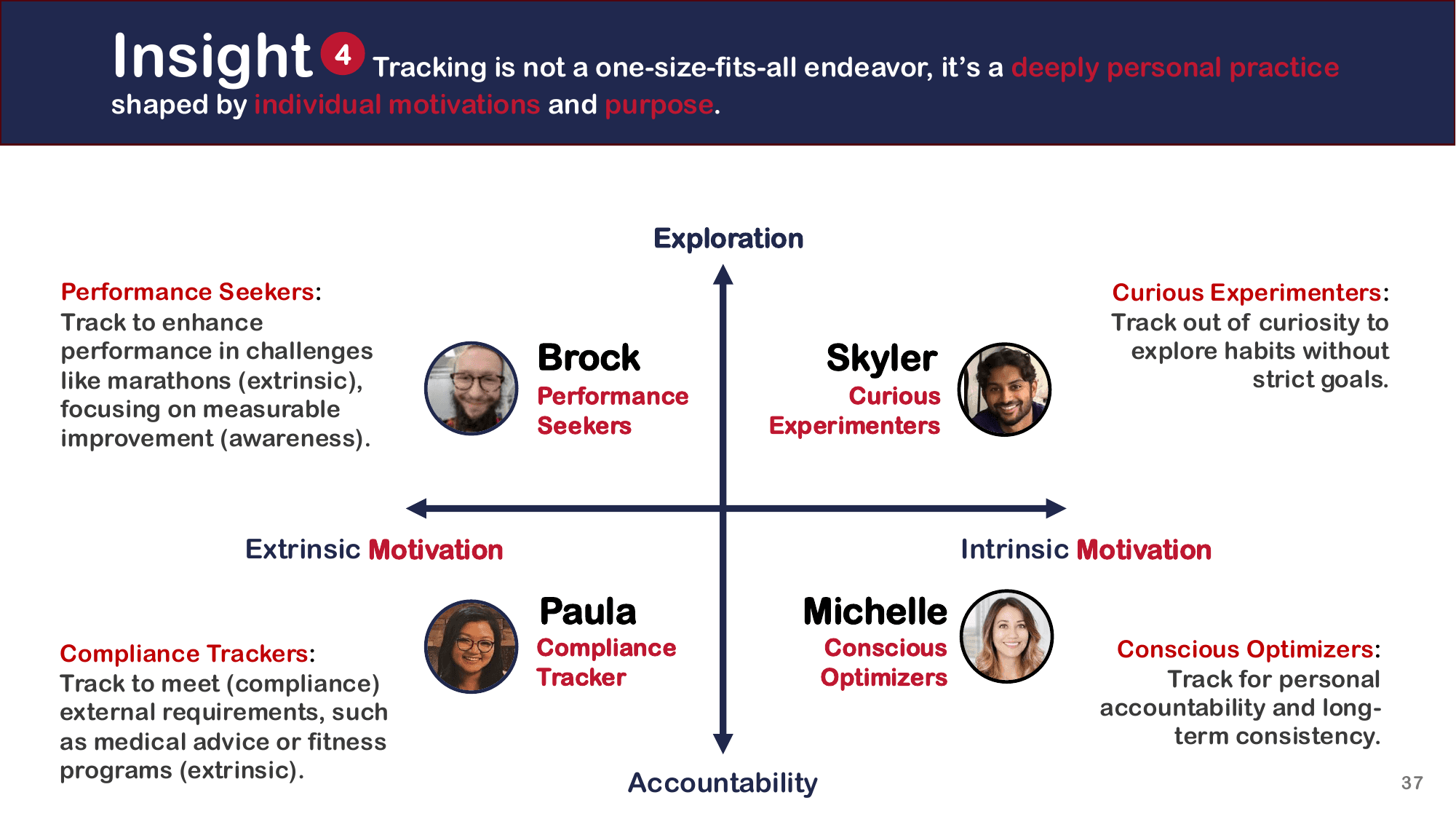
Tracking is not one-size-fits-all. It's a deeply personal practice shaped by motivation and purpose.
We mapped participants on two axes: extrinsic vs. intrinsic motivation, and exploration vs. accountability purpose. Four distinct personas emerged — Performance Seekers, Curious Experimenters, Compliance Trackers, Conscious Optimizers — each with different openness to a brand intervention.
“Tracking every little thing all the time soon became tedious and time consuming. It was a lot to take on psychologically, and I started having feelings of body dysmorphia.”
The solution: Barilla For You
Two complementary moves that reframe Barilla as the easy answer to "what should I eat for my goals" without sacrificing pasta's role as a comforting staple.
Health Bits
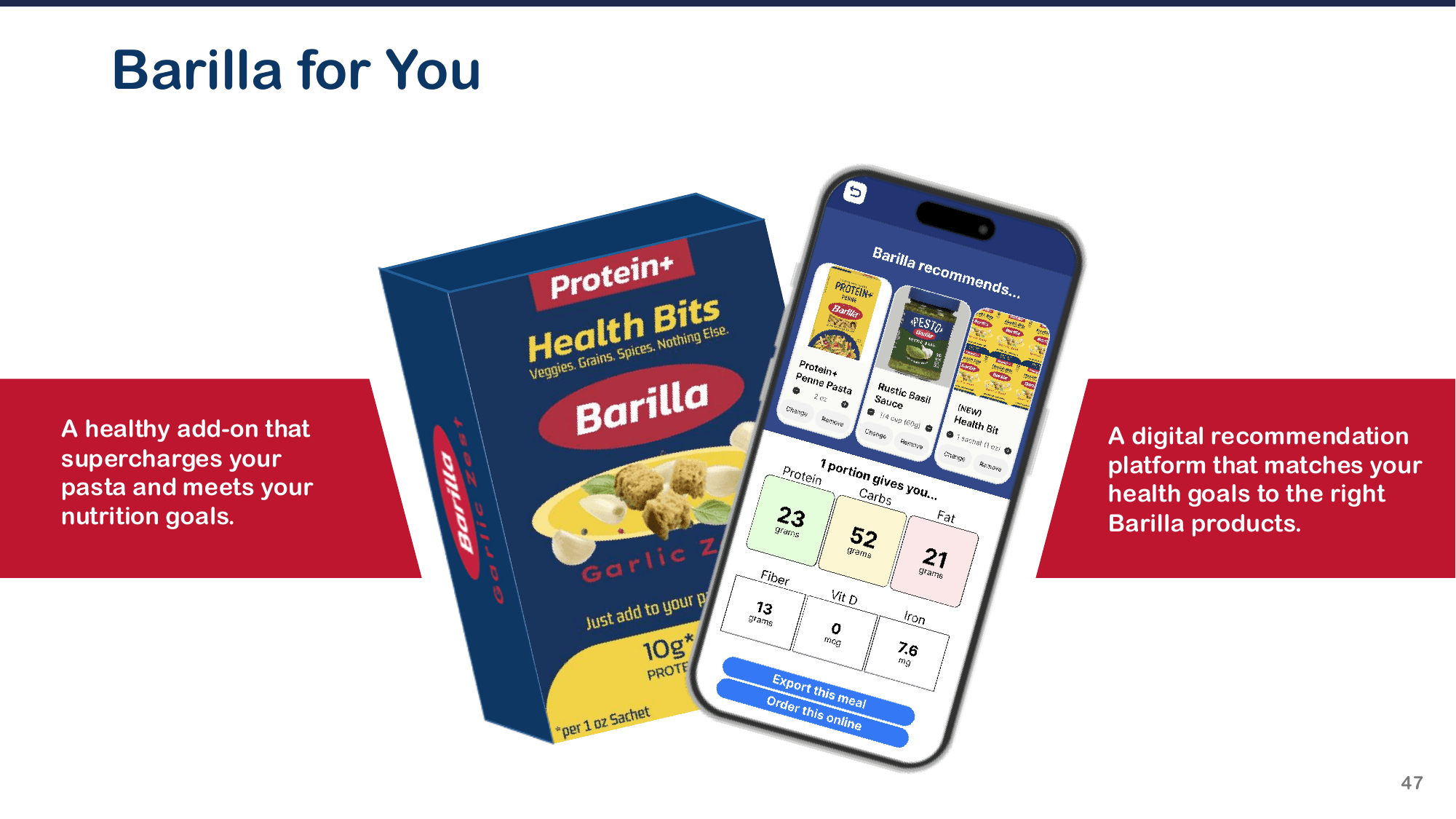
A protein- and fiber-fortified topping you sprinkle onto a regular plate of pasta. No reformulation of the pasta itself; a low-friction add-on that delivers macros without asking customers to give up the shape, texture, or brand they trust.
Barilla For You Quiz
A digital recommendation experience — accessible via QR on the box or independently online — that matches health goals to the right Barilla products and exports nutrition data straight to fitness trackers.
Following Mark
We tested the concept end-to-end through Mark, a composite participant. Six panels follow him from the moment he decides to eat better to a healthier pasta dinner with his partner.
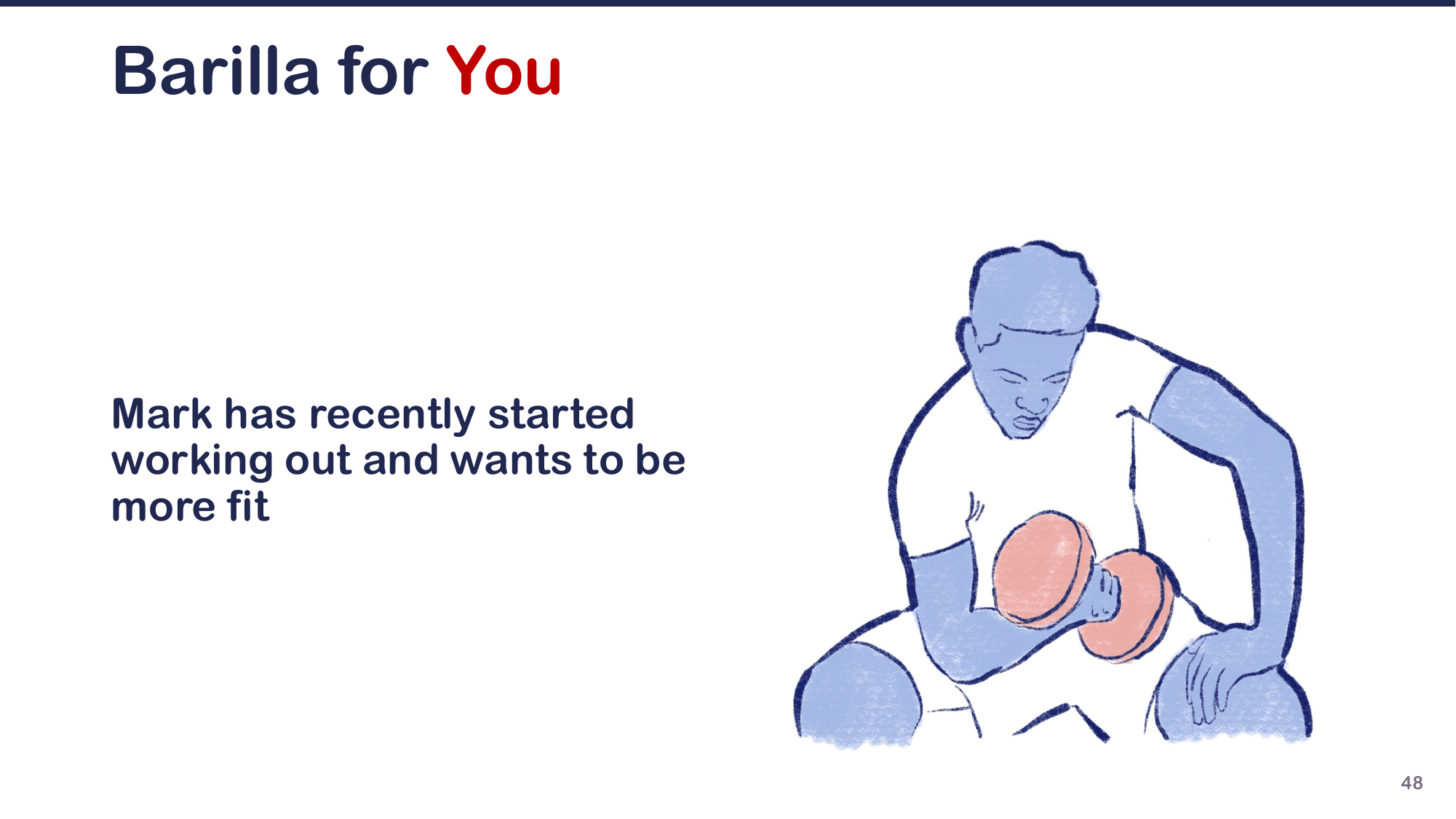
Mark has recently started working out. He wants to eat better — protein is the obvious starting goal.
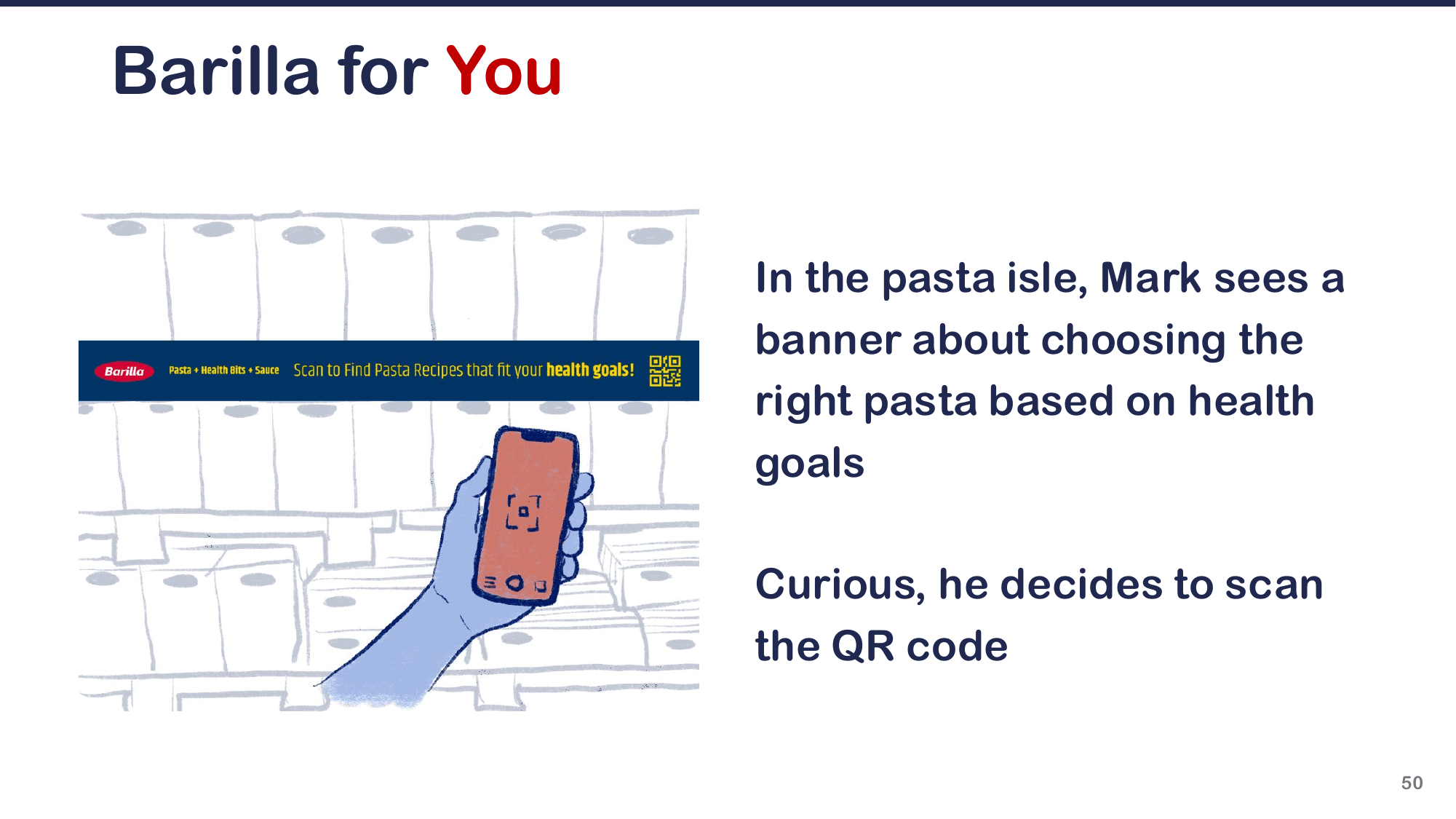
In the pasta aisle, a banner asks: choosing the right pasta for your goals? Curious, he scans the QR code.
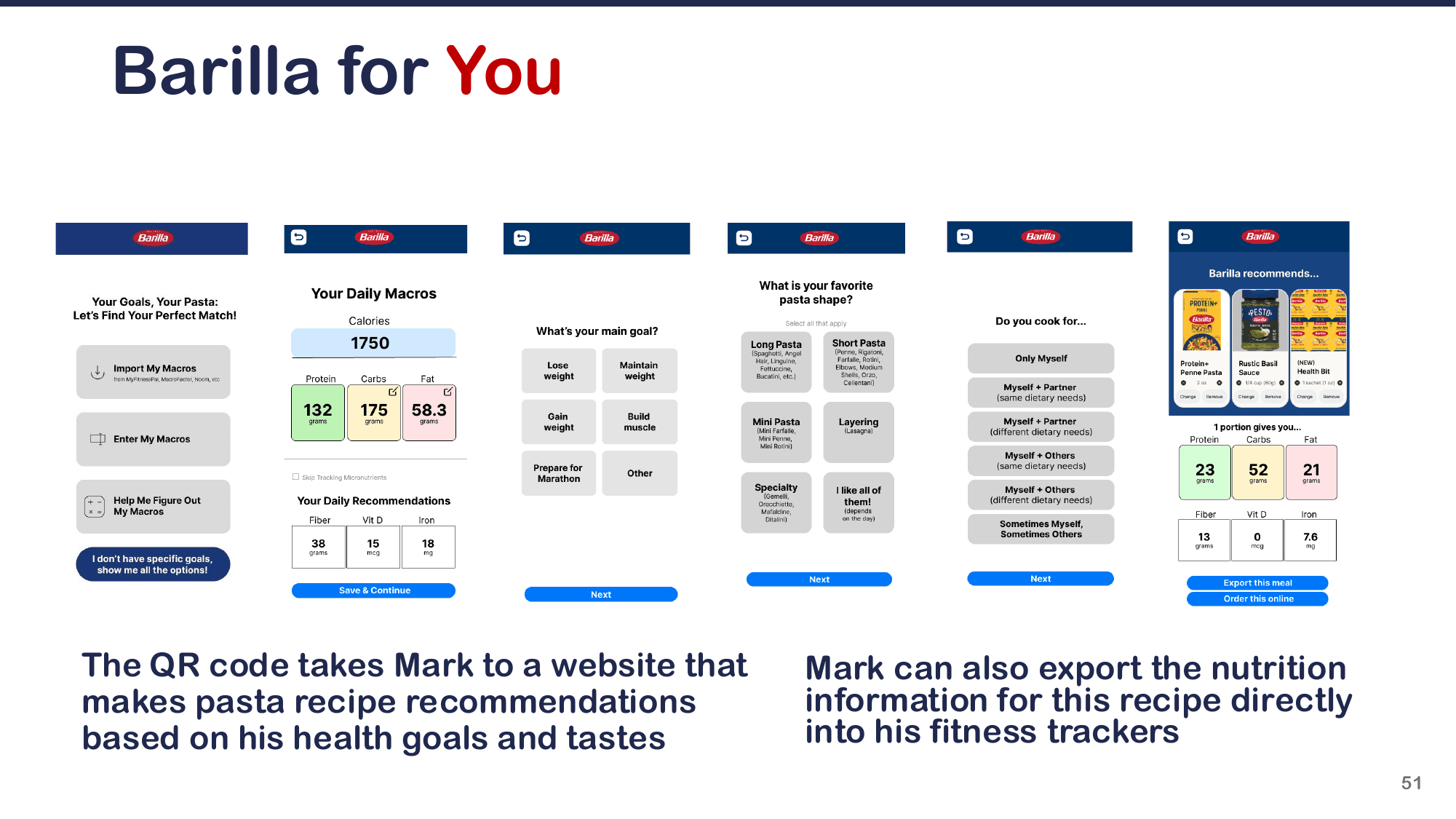
The QR opens a recommendation flow that matches his goals and tastes to specific Barilla products — and exports the meal's macros to his tracker.
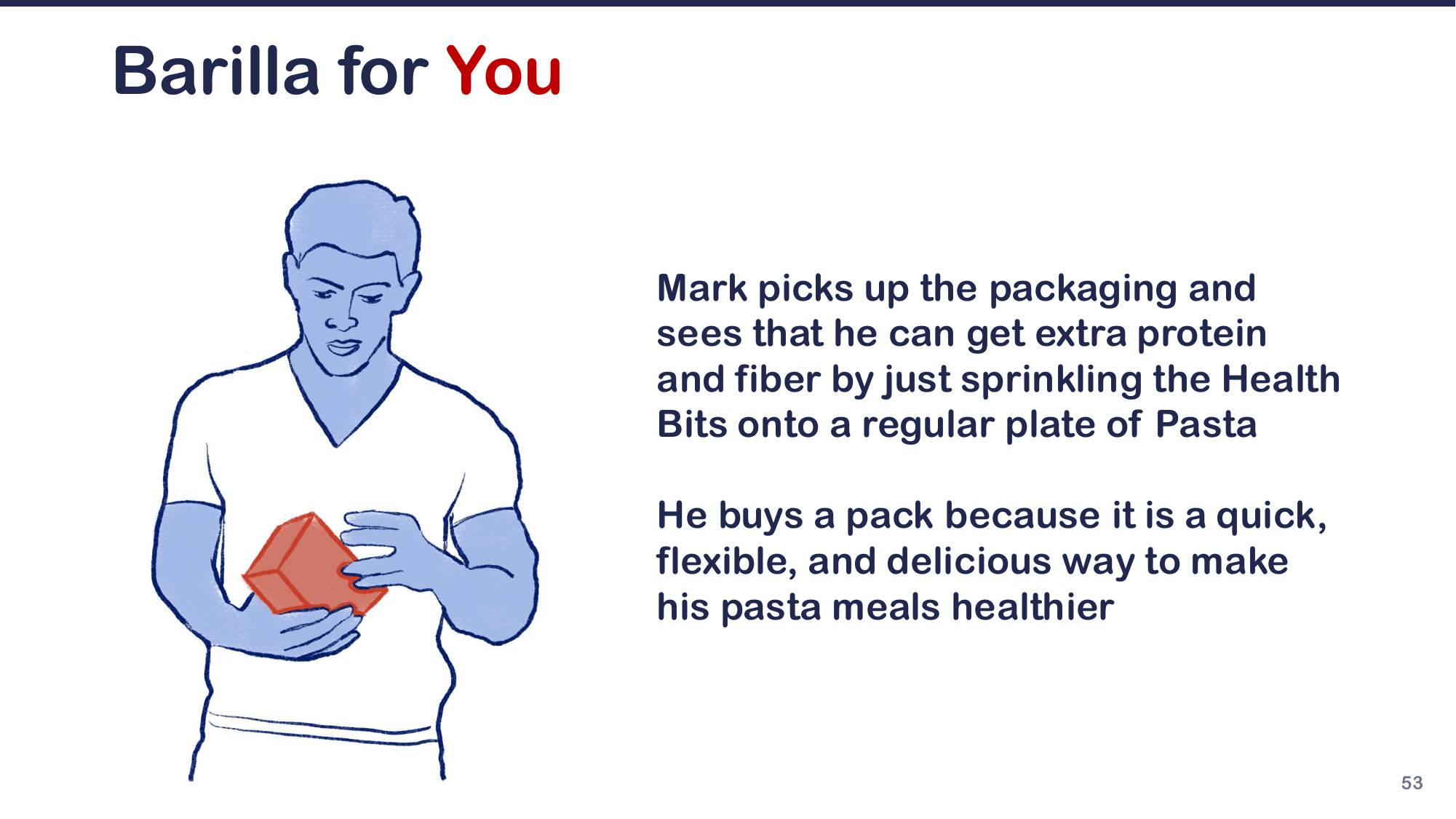
He picks up a Health Bits packet. The promise: extra protein and fiber by sprinkling it onto his regular pasta. Quick, flexible, no taste sacrifice.
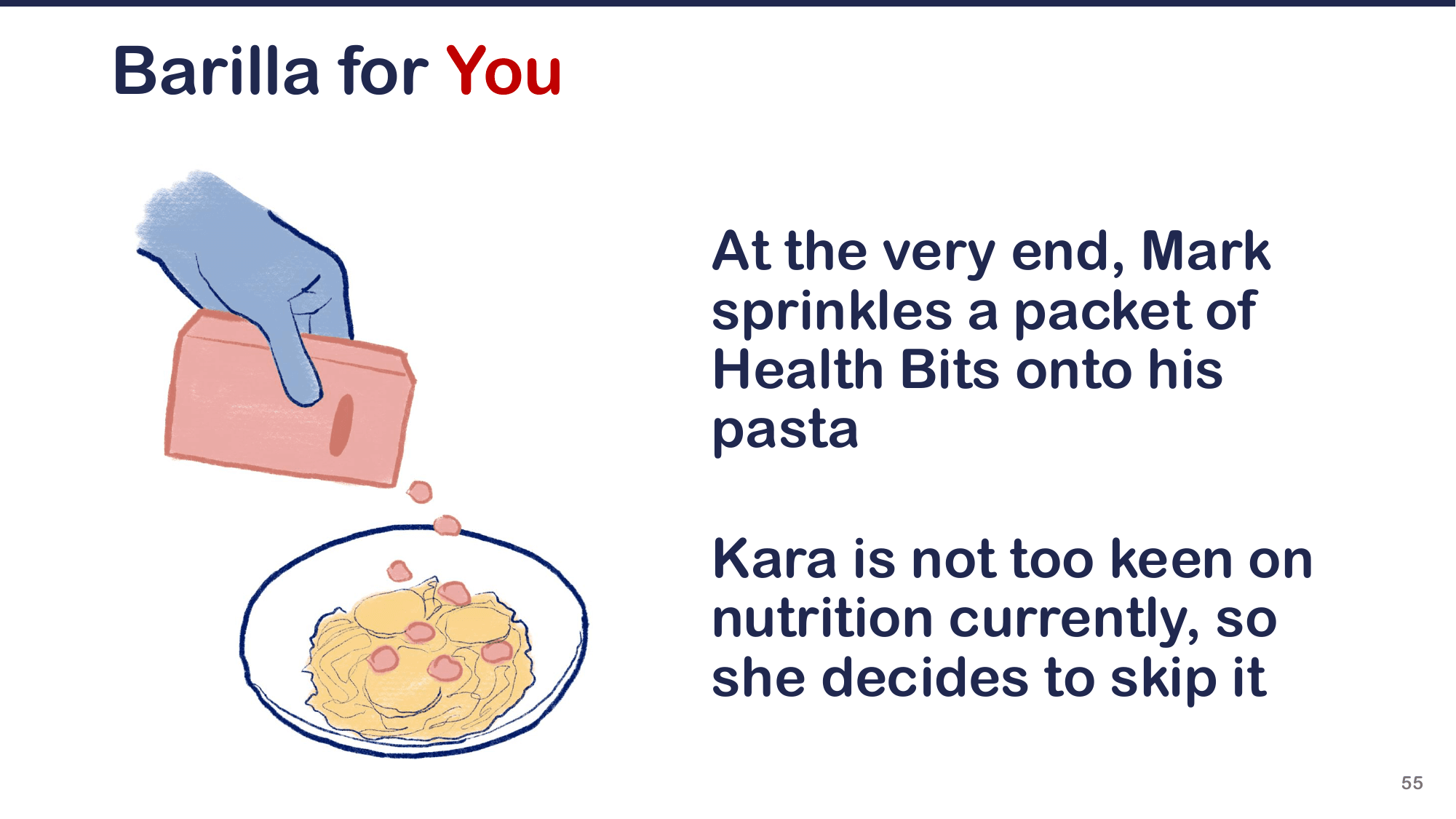
Back home, Mark cooks pasta the way he always does — and adds Health Bits at the end. His partner Kara, less goal-driven, skips them. Same dinner, two paths.
What testing taught us
- 01
Pasta is sacred
76% picked Barilla classic. The brand is a non-negotiable comfort anchor — innovation has to happen around the pasta, not in it.
- 02
Sauce + add-ins are the playground
76% bought sauces with their pasta. The decision-making load — and therefore the room to add value — sits in what goes on top of the pasta, not the pasta itself.
- 03
Health Bits sparked 'cheat code' joy
53% bought them. The strongest reactions: parents excited to sneak protein into kids' meals, and trackers framing them as a 'macro cheat code.' But 47% were confused about what they were — naming and shelf placement need work.
- 04
QR engagement was low in store
Only 1 of 17 scanned in-aisle. People in stores are in transactional mode. The recommendation flow needs to reach them at home, before the trip — that's a media strategy problem, not a UX one.
The way forward
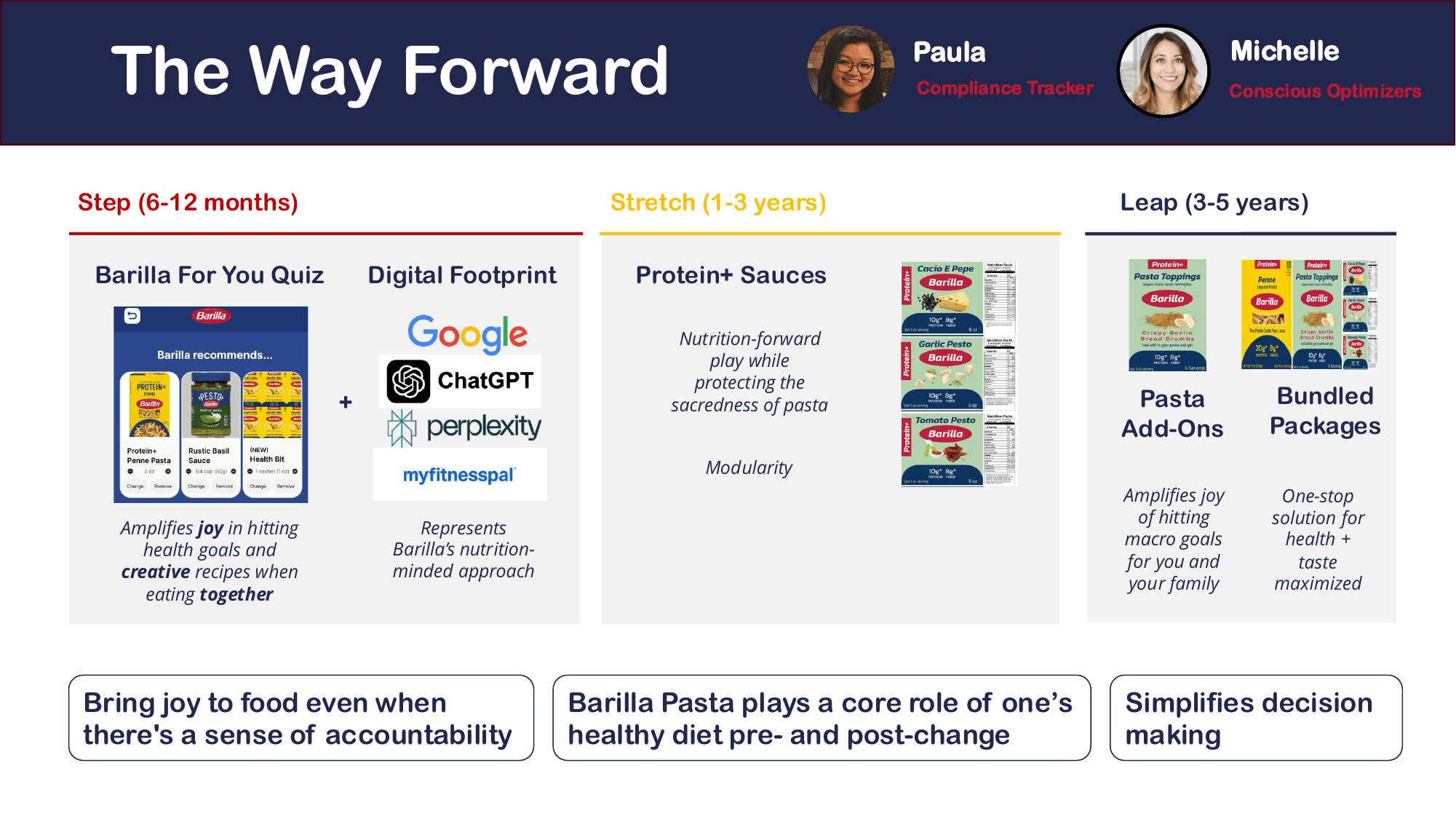
We left Barilla with a phased roadmap: small now, ambitious later. Each stage protects the brand's heritage while pulling it into the AI-personalized-health conversation.
Step · 6–12 months
Quiz + digital footprint
Launch the Barilla For You Quiz as a standalone web experience. Establish presence in the searches and AI conversations where Barilla is currently absent.
Stretch · 1–3 years
Protein+ sauces
Move the nutrition-forward play out of the pasta itself and into the sauce category — preserving pasta's 'sacred staple' status while delivering macros where consumers will accept them.
Leap · 3–5 years
Pasta add-ons + bundled packages
Health Bits scale into a full add-on platform. Bundled packages (pasta + sauce + add-on, sized for goals) become the one-stop answer for the AI-prompted 'what should I cook tonight' query.
Reflection
The hardest moment of this project was Insight 2. We came in expecting to design a tracking-companion app. We left convinced that more tracking was actively bad for the people we were trying to help. The research forced us to throw out our first concept and rebuild — and the second concept was much better for it.
What I'd carry into other work: when you're designing for an emotional domain (food, health, body), the demographic axis that the brief gave you is rarely the axis that matters. Motivation and purpose ended up being far more predictive of behavior than age, income, or BMI. The 2×2 in Insight 4 came out of that reframe and became the spine of the recommendation.
If I were running this again, I'd pull product testing earlier. We spent five weeks in research before participants saw a prototype, and the "Health Bits is confusing" signal would have arrived in week 3, not week 9, if we had.
The full deck
76 slides covering the secondary research, every interview vignette, both prototype rounds, and the full recommendation logic.